museum of ethereum walkthrough
Audio
Transcript
Contents
Introduction and museum origins
00:00 Bob Summerwill: So, hello and welcome to Denver. We're going to have a little walkthrough of the Museum of Ethereum. So I'm Bob Summerwill, Head of Ecosystem at STRATO, and here we have
00:13 Kieren James-Lubin: Kieren James-Lubin, CEO at STRATO.
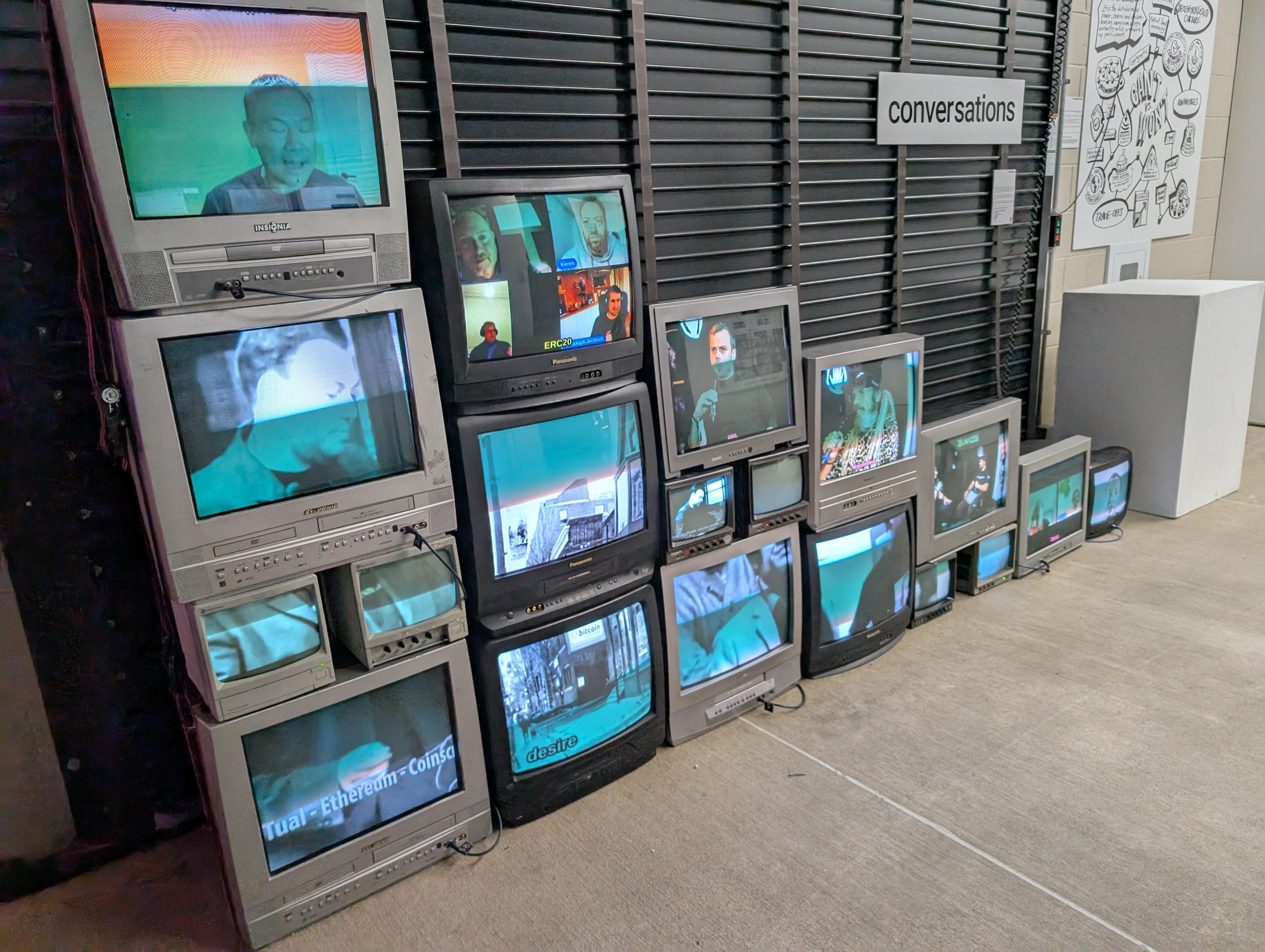
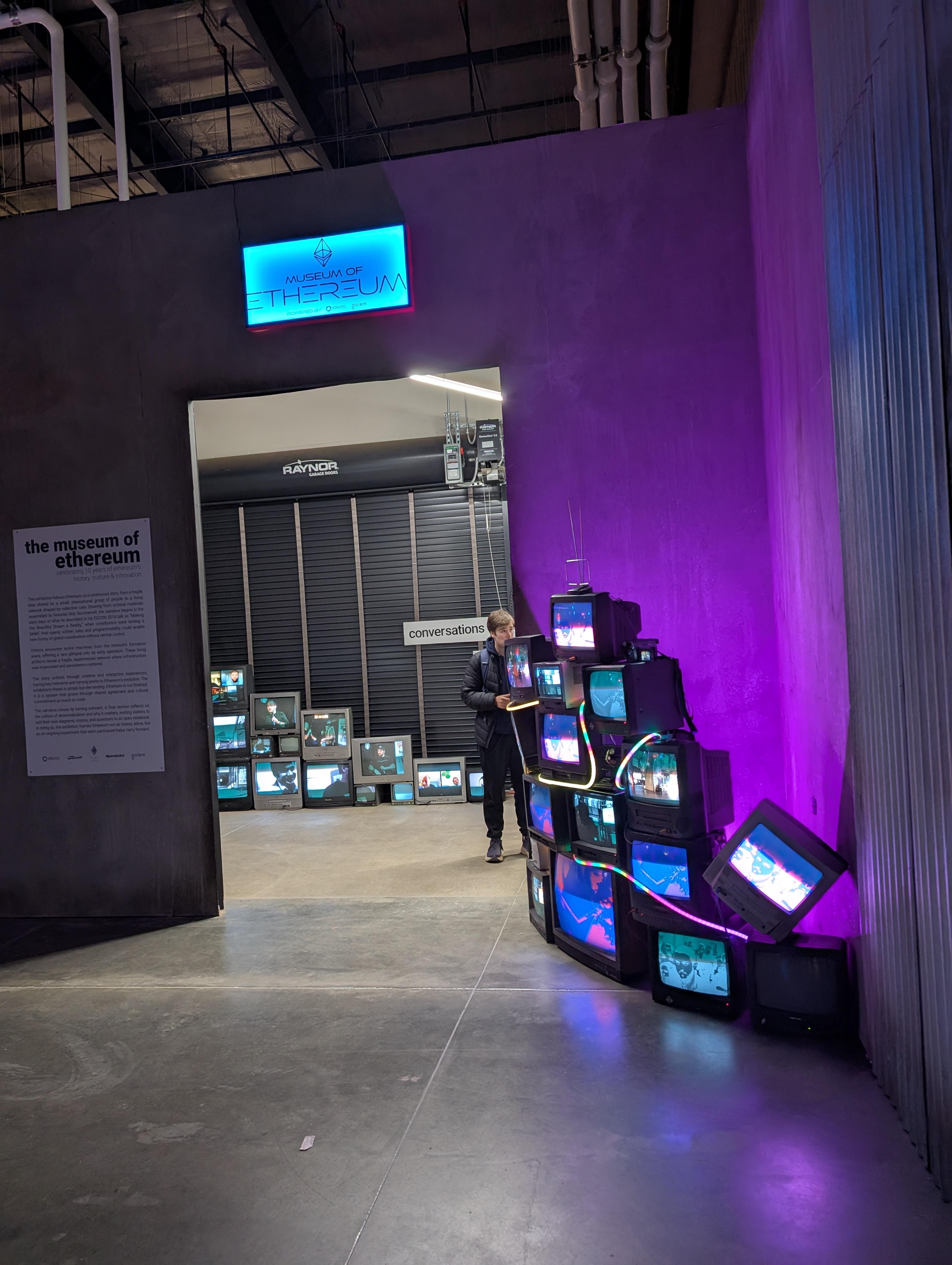
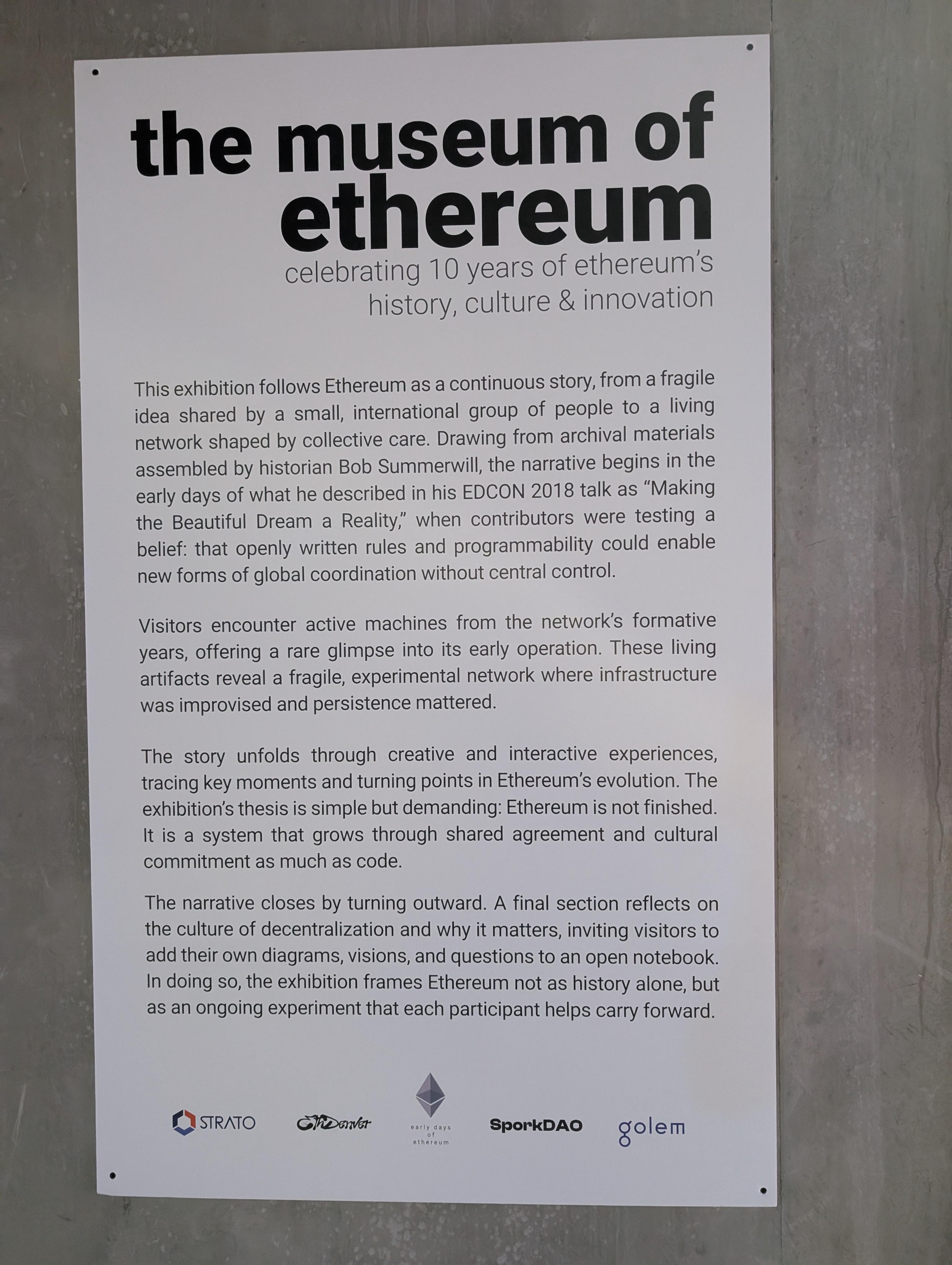
00:15 Bob Summerwill: Okay. So the Museum of Ethereum's come together over the last few months. It was actually somebody at ETHDenver's idea, maybe we'd have a museum. And they ended up contacting me and it's like, oh, you got the content. Great, we can put this together. So it's been a collaboration between myself and Jessica Angel, who is the creative director of ETHDenver. So here we are, here is the museum. We have some lovely CRT TVs here. You see yourself walking around a little bit and then we've got various sort of arty pieces. There's some background Ethereum things. There's a few sort of NFT-ish bits. I don't know what that is. Anyway, in we come.
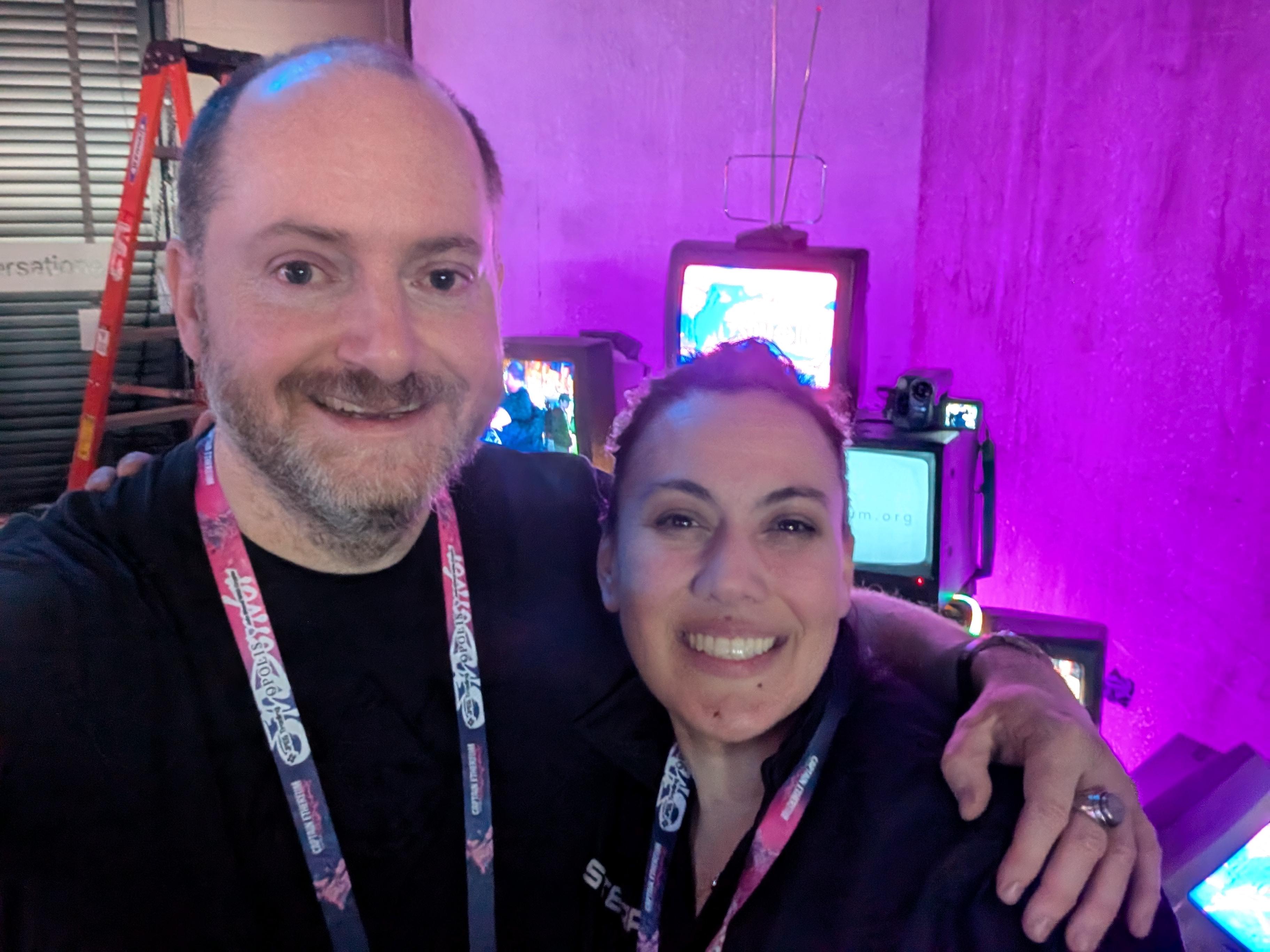
(Bob Summerwill and Jessica Angel)
So what we've got here is newer people only really often know about Vitalik and Joe maybe, and have this perception. Vitalik, the boy genius, did everything. And that was the story. But the fact is that Ethereum was always the work of many hands from the very earliest days. So here I've got about 200 people identified who had some kind of contribution in these early years. For historical reasons the period kind of ends at the end of Ming in January 2018. But a lot of the other stuff here is really focusing on 2014, 2015, the push from white paper to mainnet.
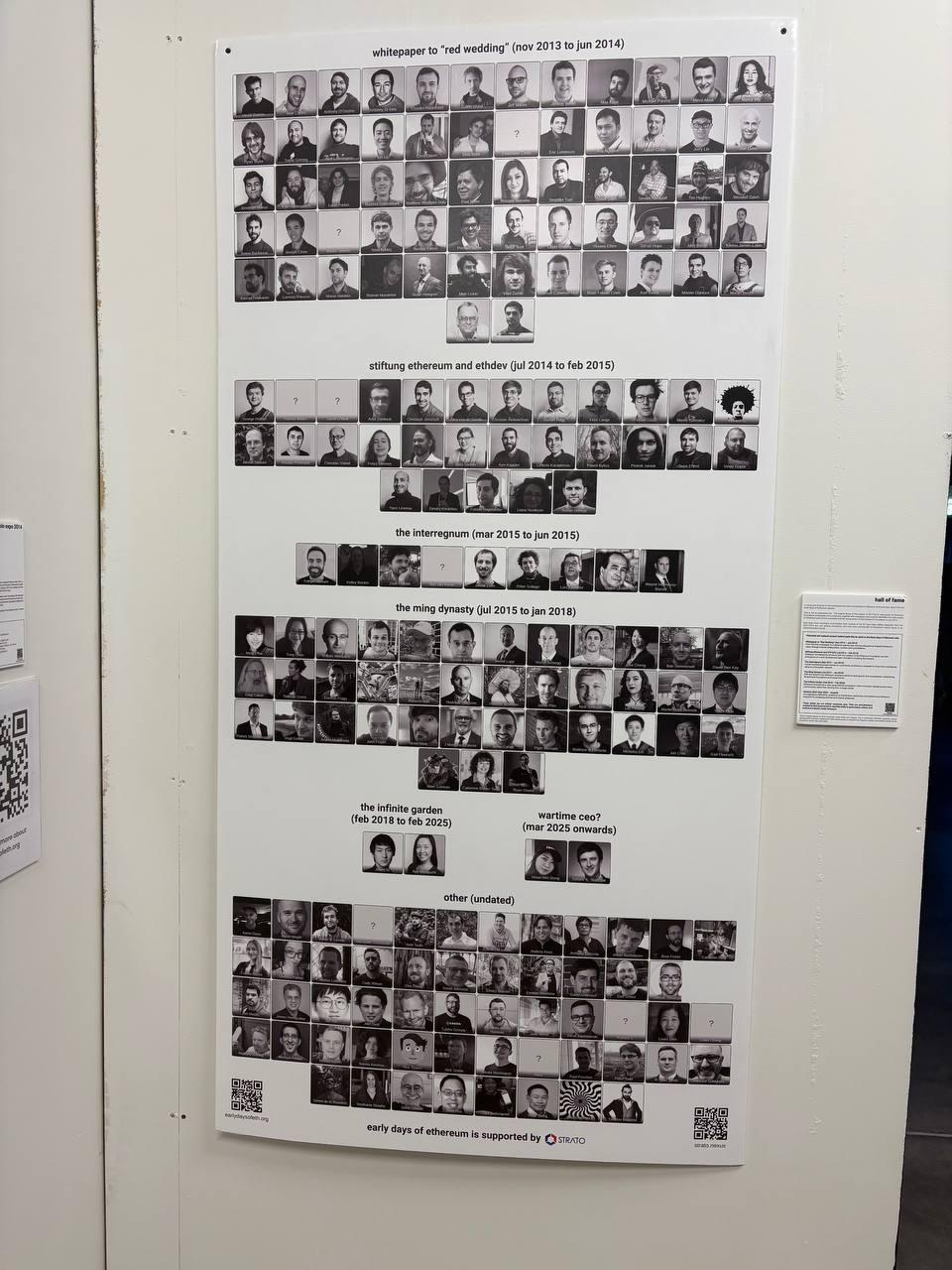
So this early period is everyone's volunteering with a pinky promise of maybe you'll get some tokens later for a network that may or may not launch. Apparently almost right up to the launch there were various people involved who were like, this thing is not going to happen.
Collective history and "ship Ethereum"
02:11 Kieren James-Lubin: I think several people did the following calculation. We were looking at the commits, mostly on the Geth client. We're building the Haskell client at this time. And they kept pushing the launch date back by two weeks.
02:23 Bob Summerwill: Two weeks.
02:24 Kieren James-Lubin: So we made a plot of the Geth commits and it launched within a few days of when you thought the commits would stop.
02:31 Bob Summerwill: So.
02:31 Kieren James-Lubin: Which was very funny.
02:32 Bob Summerwill: So that was a good prediction.
02:34 Kieren James-Lubin: And someone else told me they did the same thing. When the date kept getting moved, people were ready to know. Proprietary forecast model, like two weeks before the answer.
02:45 Bob Summerwill: Two wooks. Two wooks.
02:46 Kieren James-Lubin: Two wooks.
02:47 Bob Summerwill: Yeah. So, yeah, Kieren is here. Kieren's journey began. And yes, I mean, here, ship Ethereum. This is Ethereum Foundation. So Ethereum Foundation was formed in July 2014 and then you had the crowd sale going through July to September and then this bunch of people, they're mainly employees, right? People. There was money from the crowd sale so people would be hired. Many of the volunteers from earlier were still around and kind of became, started getting paid at that point. But yeah, through here, into 2015, it became apparent the money was nearly running out, right. Was this thing even going to launch?
03:36 Kieren James-Lubin: I've said before publicly this was a good thing because it caused the launch before when the treasury was healthy. The scope kept expanding ad infinitum. They were trying to deliver on peer-to-peer networking, file storage and the chain and a bunch of different sub-protocols. And so yeah, the wallet, the browser, the IDE.
04:01 Bob Summerwill: Let's build. Why not, let's build an IDE as well.
04:04 Kieren James-Lubin: It was, yes, it was like dev has gone wild. Like if you're like, here's a slush fund, do what you want to do. The scope just expanded. But then they had to focus and ship something, get the token out there.
Foundation structure and leadership eras
04:18 Bob Summerwill: So you had Kelly Becker here, who Lars, Vadim and Wayne came in as directors. So Lars worked at Rolls Royce, Vadim at the UN and Wayne was a sort of fintechy guy. And then you also had Ming Chan, who was the first executive director who came in, and Tung, her sister, who I met this morning for the very first time, she was here, was the legal counsel. So Ming's reign was mixed, shall we say. But we had two and a half years of that where really had a very minimal overhead. It's like Ming, Vitalik and the lawyer with a board. And then you had a bunch of devs. So there was very little internal support. The website didn't change for two and a half years. There wasn't even a grant program at all. Put in Aya, who became the new ED, and the Infinite Garden began.
So I haven't got really information turned down because it's just too many. It's not really the scope. But then in 2025 you have these changes where Aya went upstairs and you have the two new co-EDs. So I think the Infinite Garden ended a year ago. People will still use those memes, but we're not in the Infinite Garden anymore. So my title there was "Wartime CEO," really around Tomas going, the poetry's nice and all, but how about we check some features. How about we see this as a competitive landscape and you've got to move. So something like privacy. Okay. You've got 40 people in a privacy team actually working on that.
EthSuisse, Miami, and the early Foundation
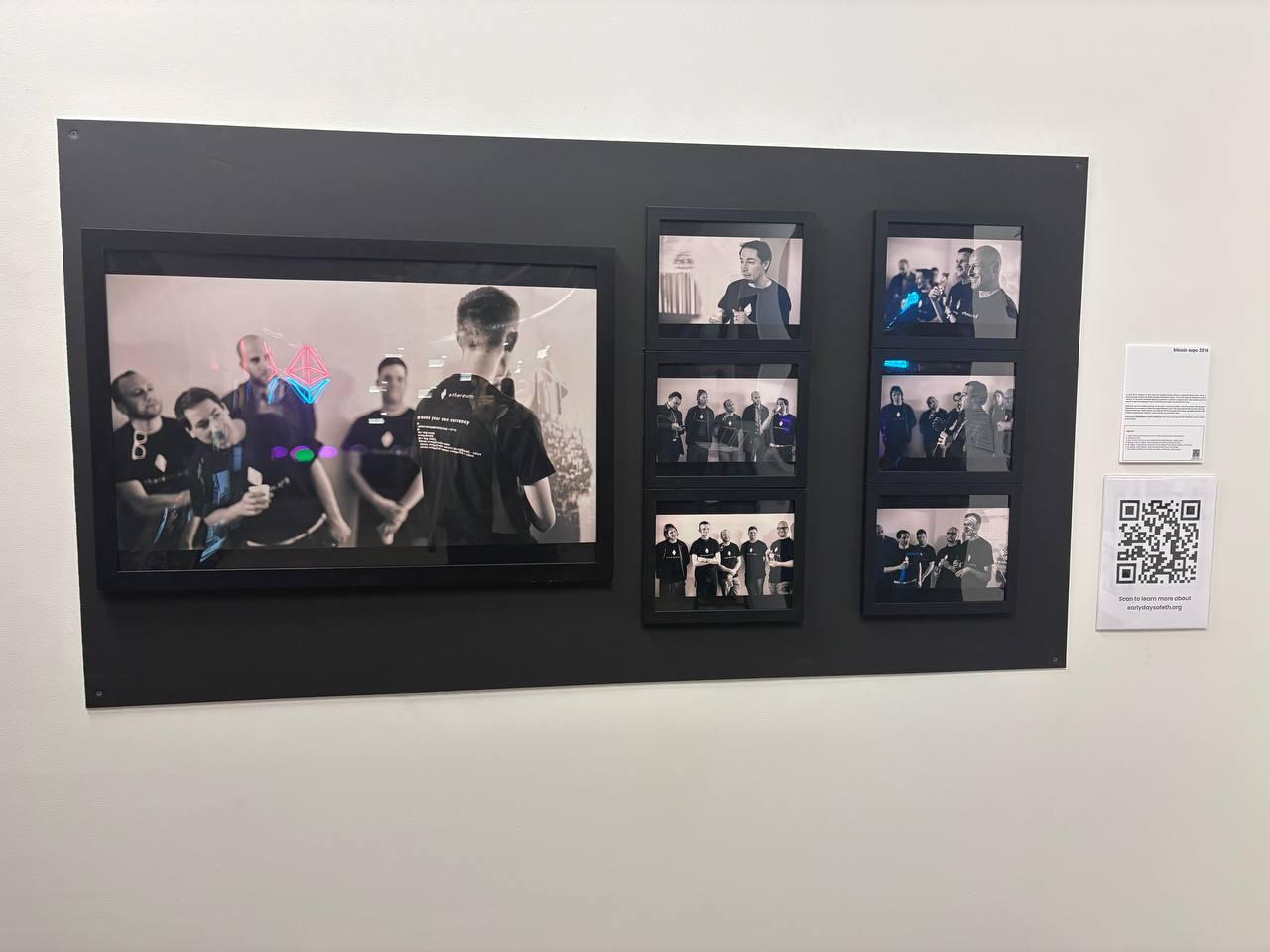
Ethereum, Ethereum as a company, as the prime sponsor of Bitcoin Expo 2014. So imagine that, a Bitcoin conference, an Ethereum company are the prime sponsor and apparently a thousand T-shirts were given away. They're on the stall, shilling Ethereum. Notably this code on the back was pretty well known but I think is in Mutan but EthSuisse.
06:38 Kieren James-Lubin: Okay.
06:39 Bob Summerwill: So yeah, EthSuisse was formed in February 2014 and it was a for-profit company in Switzerland.
06:45 Kieren James-Lubin: They didn't even realize that.
06:47 Bob Summerwill: Yeah.
06:47 Kieren James-Lubin: So they converted it to a Foundation.
06:49 Bob Summerwill: They made it shut down.
06:51 Kieren James-Lubin: It was shut.
06:51 Bob Summerwill: Shut down. So yeah, through that period. So you had EthSuisse which was formed by Mihai Alisie and a guy, I forget his name. Anthony formed Ethereum Canada as well because he, the thought was it would operate out of Toronto. Like Ethereum was, Vitalik was there. Ethereum was one of n projects happening out of Bitcoin Decentral. That was the plan. But then very rapidly some people, I think mainly around Charles, were investigating other jurisdictions and it's like, yes, Switzerland, that's the one. You don't want to come out of North America. It's like Johann Gevers who started, who took his fintech company Monetas to Zug and started "Crypto Valley". It was July before the Foundation got formed and prior to that you just got these for-profit companies. So Taylor was not co-founder of the project but he was a co-founder of the Foundation. So when the Foundation got formed it was Taylor, Mihai, and Vitalik.
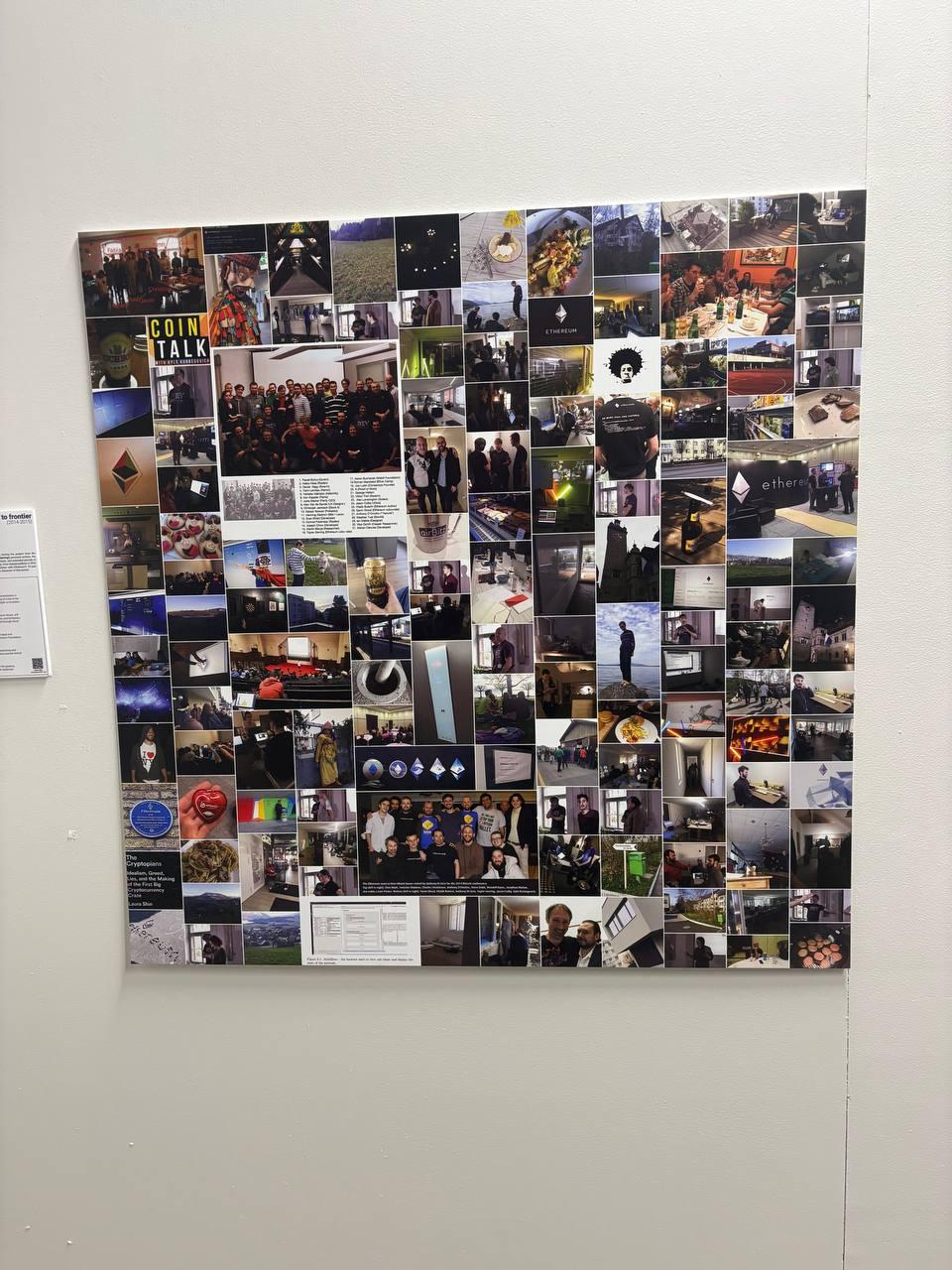
So in 2022 Taylor released these onto Twitter. Very shortly into the project it's like, right, we're going to launch Ethereum. So Vitalik was giving his talk, introducing Ethereum, the crowds of people around and afterwards all this excitement. Anthony Di Iorio had rented this house that was kind of a crash zone, hacker zone where many of them got together for the first time. So you got five of the eight here, you got Charles Hoskinson now of Cardano, Gavin Wood now of Polkadot, Vitalik, Anthony, Joe Lubin at the back there. And this is Zug gathering and this is another one which is DEVCON0. So that was October of this year.
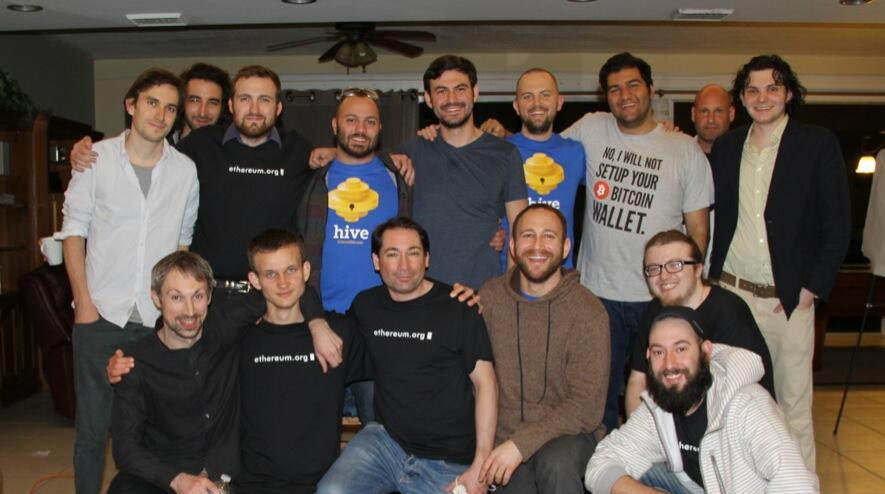
(The Ethereum team in their Miami house rented by Anthony Di Iorio for the 2014 Bitcoin conference. Top row: Dino Mark, Yanislav Malahov, Charles Hoskinson, Anthony D'Onofrio, Steve Dakh, Wendell Davis, Jonathan Mohan, Joseph Lubin, [REDACTED]. Bottom row: Gavin Wood, Vitalik Buterin, Anthony Di Iorio, Taylor Gerring, Jason Colby, Kyle Kurbegovich - from Taylor Gerring's photos)
DEVCON0, the archive, and the timeline
08:57 Kieren James-Lubin: So part of my confusion on the other point, at some point I think I had an ethereum.org email, right? It was pretty early, it was like April. So I would have assumed that they had a Foundation associated with the Ethereum.
09:11 Bob Summerwill: Not at all. They just had the domain I think.
09:14 Kieren James-Lubin: I think like only some people were invited to DEVCON. I don't know how they, like it—
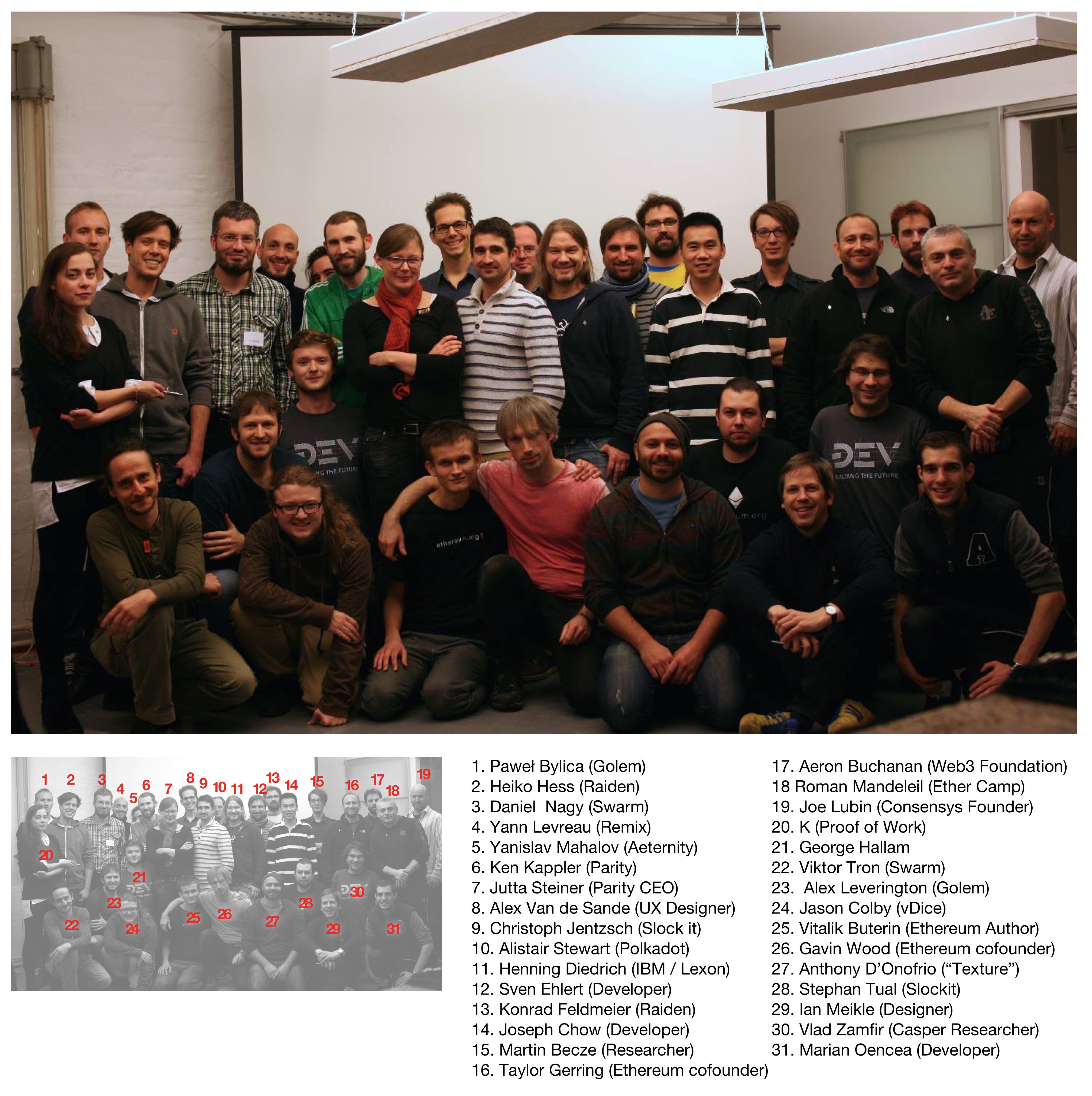
09:19 Bob Summerwill: It was primarily people who were working for the Foundation or for ETHDEV. So ETHDEV was like, those again, they were for-profit. Maybe not for-profit but it's like you've got these development places. So Berlin was where Gav's "Fortress Berlin" was. In Amsterdam you've got Jeffrey Wilcke and the Go team. Though talking to Zsolt yesterday, not many people were actually in Amsterdam. That was a lot more remote that team whereas Berlin, they were physically there. You had like communication people in London who were there as well, who paid to that. And there were some people in Switzerland still at that point. But largely the people actually in Zug, really just those early.
I mean, so the Early Days of Ethereum project. So that got a website with lots of biographical detail on all of these people, gathering together a bunch of videos, articles, photos from all these times. And then the other thing that we've got is these conversations. So now every two weeks we're doing a new video release on there. So we've got them on these computers here. It's just early days of ethereum.org and it's all sort of wiki style, right? So you can go off and explore, follow the links. At the bottom you've got a bunch of backlinks as well. So wherever these are referenced, go off and explore.
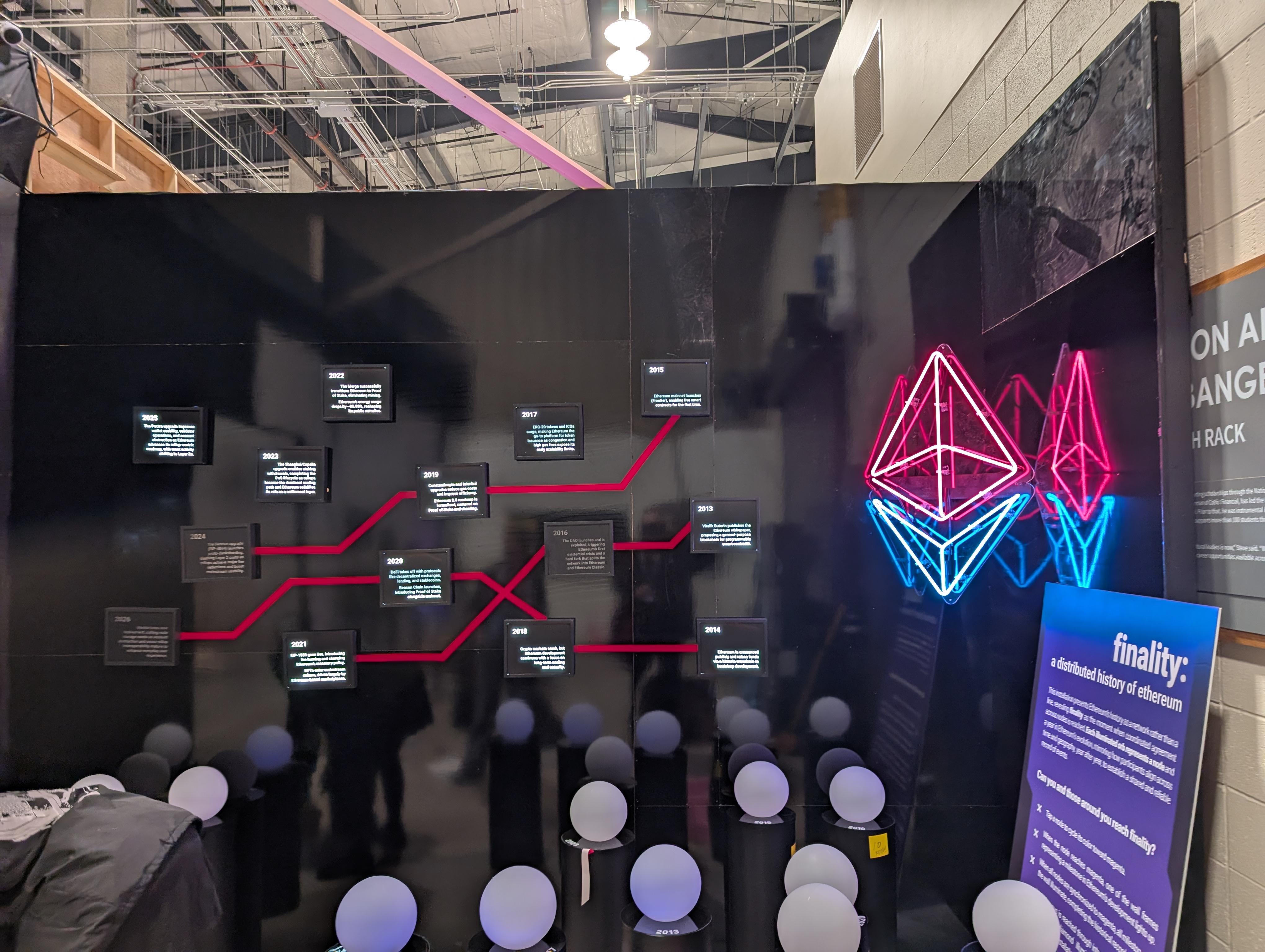
And then on the timeline, there you go, "Crypto Valley", aforementioned Johann Gevers, then white paper in November, launch here in January and so on. And so a link here to all of Taylor's photos. So you can see all of these going through his timeline.
The Ethereum Time Machine
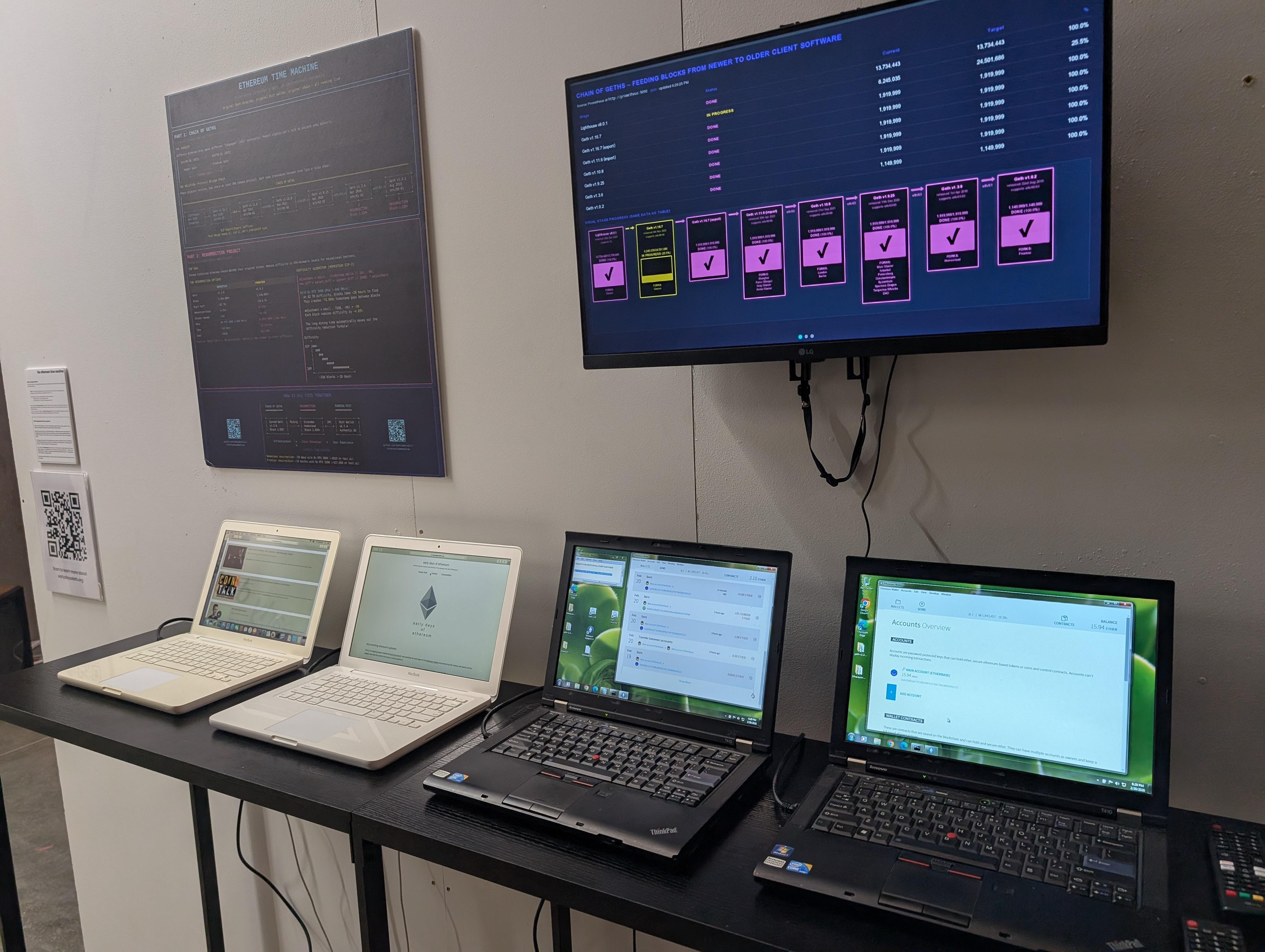
So the Ethereum Time Machine, the intention is to give people a hands-on experience of what Ethereum was like in 2016. So these computers are actually your 2010-era original hardware. The problem is if you want to run that old software, if you start up, because these are original binaries that are on here, right? These are 10-year-old original binaries. If you start a Geth client that's old, it won't actually manage to peer with anything because as well as the protocol itself updating, the peer-to-peer discovery protocol has changed over time as well.
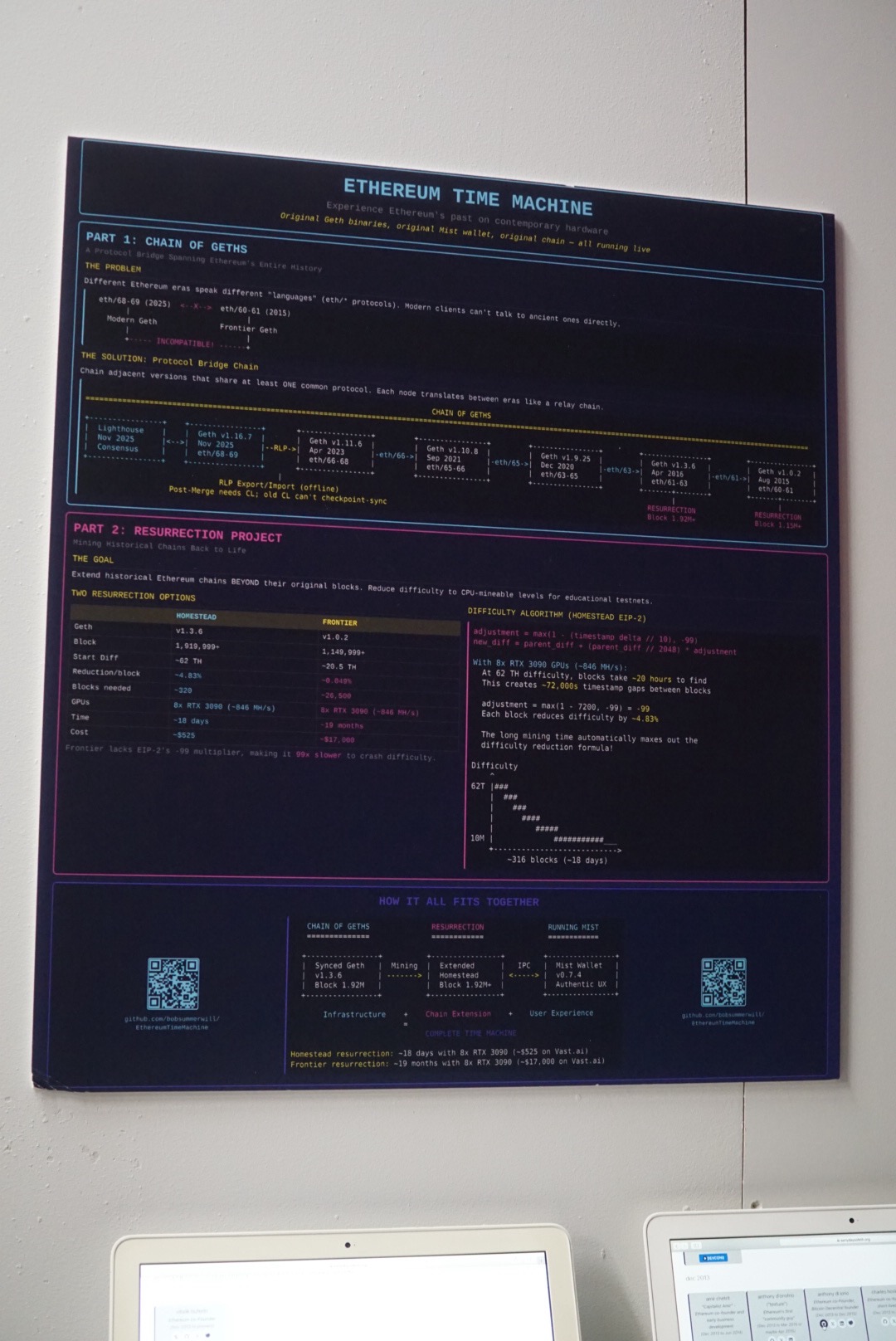
So here we've got contemporary Lighthouse and Geth pairing. So those were 2025 and those can talk to a slightly older one from 2023 and that can talk to one from 2021, 2020, 2016, 2015. And you can go all the way back down the line and end up. Turn this on and you can basically end up with synced nodes as of 2016.
Resurrecting Homestead and the difficulty bomb
So then phase two is blockchains never die, right? When you have a hard fork, it's just convention that everyone's like, right, the new one's Ethereum, right? We leave the old one behind. But with the exception of ETC, where you had a contentious chain split and both sides survived, most updates, you just don't. It's just not a problem.
Anyway, so what I did is resurrected the Homestead chain. So Frontier was the very earliest protocol in 2015, sorry. Homestead was the next, but launched on Pi Day in 2016. Very geeky. 3.14, 14th of March. So I rented a bunch of GPUs. So it started with 16 1390s rented, hashed. You can see here a live sort of demo of this chain of Geth. It's actually completed and they've gone down the line here and there you go. These are up to date.
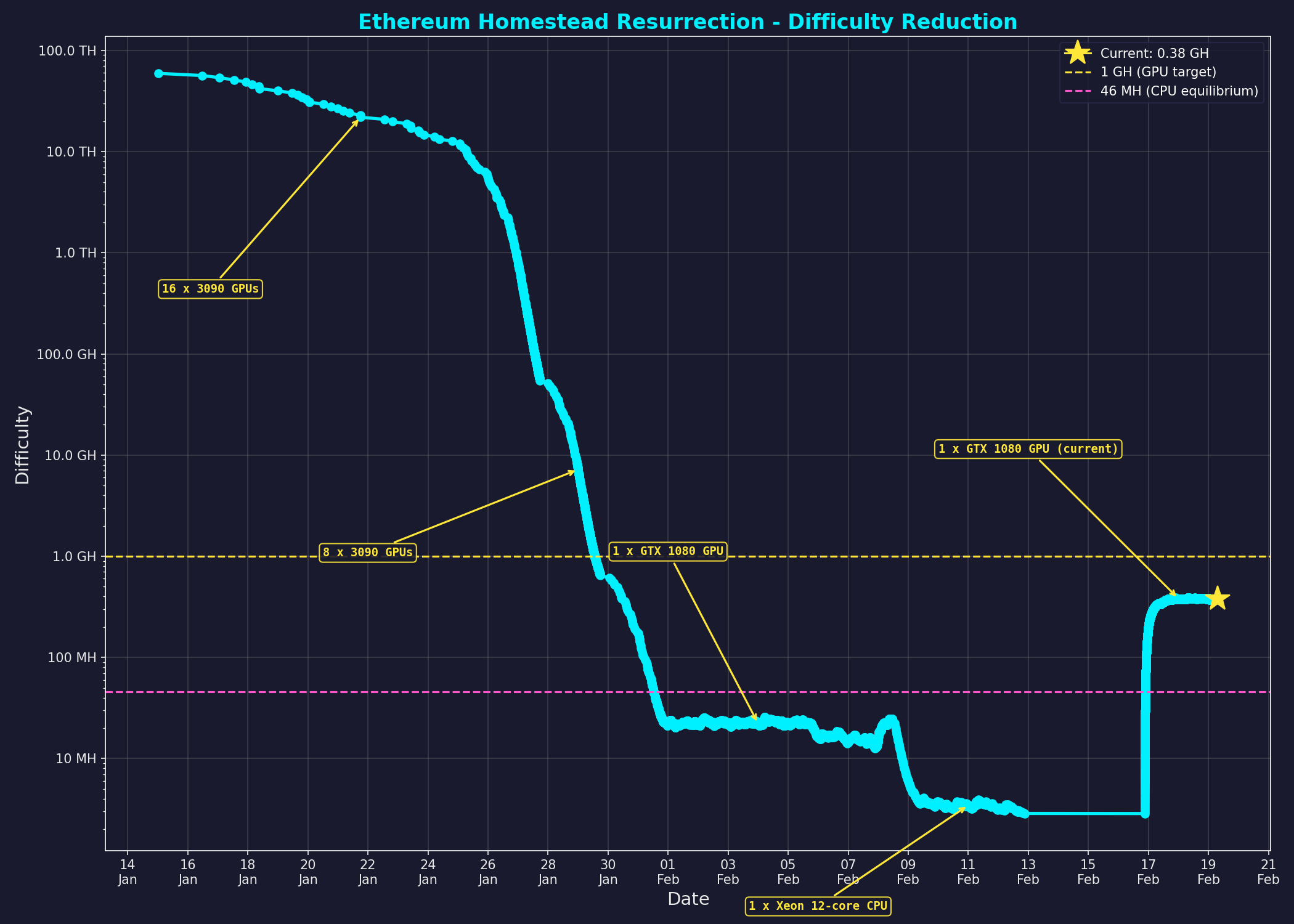
But yeah, so I mined the old chain. The problem is the difficulty at that point is the network difficulty that there was at the time, all the miners that were mining at that time, that's the difficulty. So it took two days of 16 GPUs to mine the first block. But then you can see here, if you keep going and you keep going, it does eventually die down quite a lot. So this is sort of like January through the February timeline here, starting with 16 GPUs, then eight, then one, then a strong CPU. And the goal, so it's crashing down by like 99.999% difficulty. This is terahashes and gigahashes and megahashes coming down. That's a log graph.
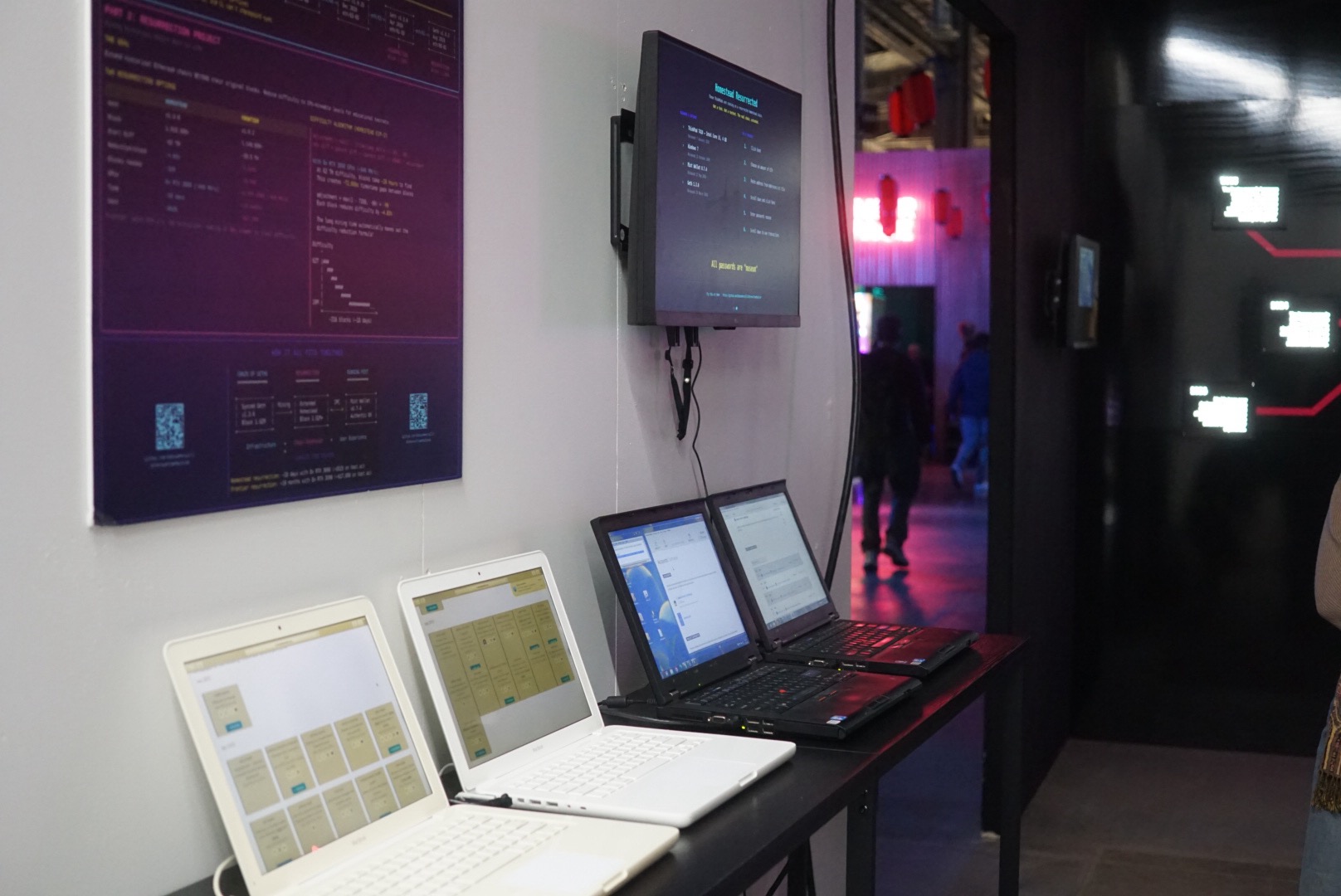
I did intend for the mining to be literally on these four laptops. And that can happen. The problem is you've got the difficulty bomb, which, when you've got like no, right. So yeah, so the difficulty bomb was something that was introduced, I think from the very start on Ethereum, they're saying, as well as the normal difficulty adjustment, where if blocks are too slow, it makes it easier, if they're too fast, it makes it harder, right? So you're wanting a consistent rate. Difficulty bomb was an additional mechanism basically saying, okay, we're also going to make the difficulty just sort of go up over time so that the blocks, the block times are really slowing down and it's grinding and it's unusable. And that was intended to basically push the hard fork.
15:47 Kieren James-Lubin: It's like, right, to force the proof-of-stake switch.
15:51 Bob Summerwill: Yes. They're basically saying, right, we're going to go to proof of stake and we're going to force that transition by gimping the proof-of-work chain basically. So that stuff was coming in, it got reset three times maybe.
16:10 Kieren James-Lubin: So we had to put this in for mainnet compatibility. But sometimes we have like an enterprise deployment.
16:16 Bob Summerwill: Right.
16:17 Kieren James-Lubin: Why are the blocks slowing down and—
16:20 Bob Summerwill: Like—
16:23 Kieren James-Lubin: Difficulty bomb equals true or not.
16:26 Bob Summerwill: The bomb was delayed a number of times and actually funnily enough on ETC there were two changes to that. So the first one was a delay and the second after a while was a defusion. So it was defused and removed in ETC while later basically because the intention has been proof of stake forever. So you don't need that nudge. But that was an intentional sort of thing to sort of force, you can't just sit on the old one and it's going to keep going. It's getting screwed. You have to fork away from all the things to survive.
Mist demo
But yeah, what you've got here if you look, is this is the Mist wallet running with, we've got a Geth node here. I've actually got, I have got this mining. I just changed that today. This is mining as well, as well as that one GPU. So actually the balance here should occasionally be popping up. But this was the first sort of GUI wallet and so what you can do here is do a transaction. So we're going in the time machine back to 10 years ago to do a transaction with this. So the way you go, pick your. So highlighted here.
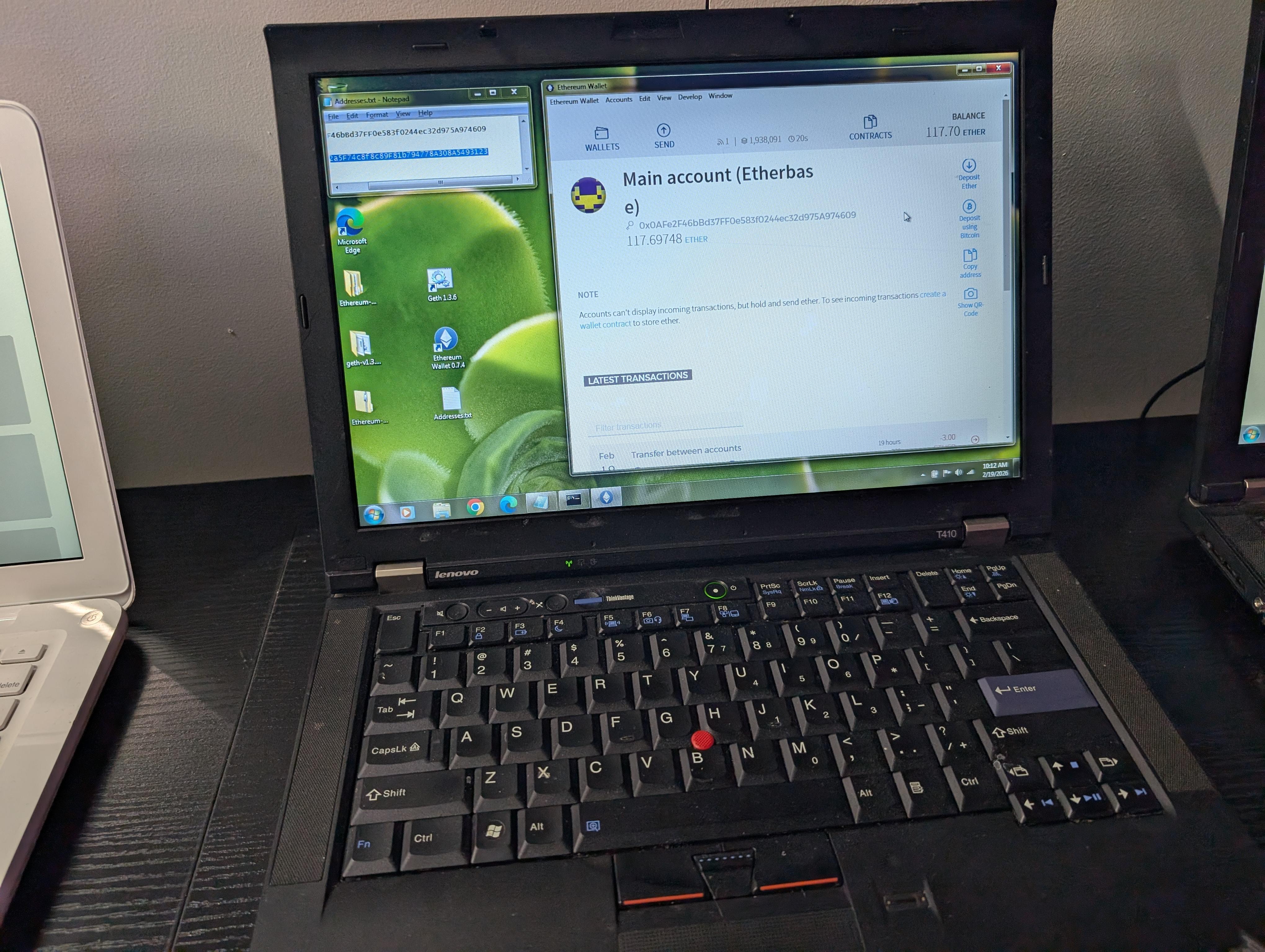
17:41 Kieren James-Lubin: Yeah, make sure we copy.
17:43 Bob Summerwill: So at this point there wasn't like an address book thing in this. So you have to type in the hex here. Thankfully the cut and paste does just about work. So we've got 76 ether picking them out. Okay. Then you annoyingly have to scroll right down to the bottom to find the send.
18:02 Kieren James-Lubin: Oh yeah. So I can add the data?
18:04 Bob Summerwill: Yeah, you can stick a bit of something in. I think it has to be like hex.
18:11 Kieren James-Lubin: Oh, it has to be hex.
18:12 Bob Summerwill: I think so, yeah. Just some thing. There you go. Dead beef. Right, so we've got this pop up and then the password is "museum." Yeah, right. And then you sit and yourself. If you scroll down to the bottom there is a list of transactions. So you should see a grayed out pending one here. So the average, all right, so 22-second average block time, that should go to 66 and 104. Yes, one confirmation, 66, 04. There we go. We have transacted now. There you go.
At some point I'd like to see if somebody with some DAO tokens would like to share them back if they have them at this point, right. And you have Mist coin as well. I don't know when the other ERC-21 started. There is GavCoins. There are these relic coin people in them who like these resurrected ancient deployments, some of which were pre-ERC-20. So they have their wrapped. But yeah, you can get wrapped GavCoins. You can trade them around. Sure, why not.
There is a thing in here for doing, that was just a normal account but you can do, you can create a smart one. I think I did. In here is, there is a wallet one. So that is not just a user controlled. It is actually a deployment. Anyway. There we go. That's the start. Time machine. Time machine.
Closing reflections
And then the final piece here. Well, ST vinyl. So the intention here was that you've got this timeline of things that happened in years and if you touch these globes they cycle through the colors and when you got went to Modenza, light up. Anyway the electronics didn't work and it screwed for that one. And then we just got TV with small videos here. The process seems to have gone, so never mind. But yeah, so Early Days of Ethereum. That's got all the website content. For the Time Machine here, it's on my GitHub, so bobsummerwill/EthereumTimeMachine. And I think that's about it.
21:07 Kieren James-Lubin: There's always. I know I owe like, I gotta comb through those old emails. There's a lot that happened that I just forgot entirely.
21:18 Bob Summerwill: Right.
21:19 Kieren James-Lubin: But yeah, it's, I think, definitely appropriate here at ETHDenver and it came together sort of better than I thought it would.
21:31 Bob Summerwill: It was only like a couple of days, maybe the day before this opened. I think that I first did the, okay, I've got the money in the Mist and they work. It's like they were synced, but is it going to work? Can they do that? And sadly, the Macs did not quite work. Windows is very, very backwards compatible. Macs, this is not. Anyway, there we go. Museum of early days.